Timor Leste
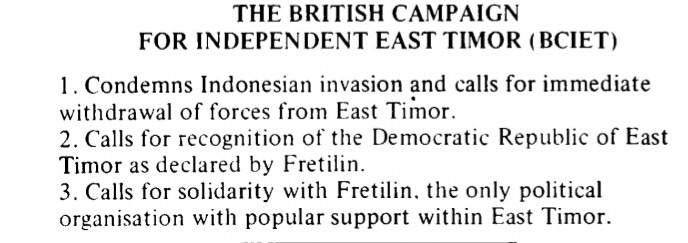
FRETILIN

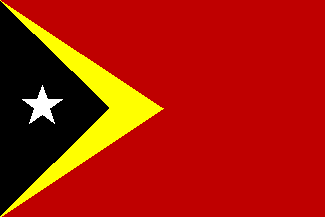
The national flag was adopted on May 20, 2002, when East Timor achieved full sovereignty. The black represents more than four centuries of colonial repression, the yellow the struggle for independence, and the red the suffering of the East Timorese people. The white star symbolizes hope for the future.
1 INTRODUCTION
The invasion of East Timor - under Operasi Seroja (Operation Lotus) - began on 7 December 1975 when the Indonesian military (ABRI/TNI) invaded East Timor under the pretext of anti-colonialism and anti-communism to overthrow the Fretilin regime that had emerged in 1974.
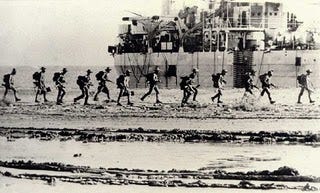
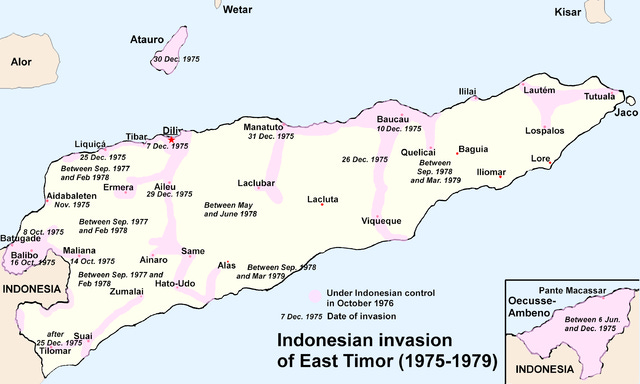
By January the next year, after two months of full-scale invasion - up to 30,000 land troops, aerial bombing, naval blockades, etc. - Indonesia did not managed to control even formally any territory beyond Dili, the capital or even along the coastal strips. The Indonesian forces were only able to control less than one-third of the territory:
This inept operation was much to the chagrin of the Australian establishment where her intelligence services were predicting a swift and ‘not too bloody’ annexation of the country by Indonesia. It is apparent then that many of the neo-colonial and imperial powers were expectant that the Indonesian invasion would be effective. That they were even expecting limited resistance by the Revolutionary Front for an Independent East Timor (FRETILIN). There would be followed by short-lived flurry of international protests, and then the issue would be buried. Once the Indonesia’s aannexation had ‘restored peace and security to the region free states’ (that is, it would become like one of the many military dictatorships of Southeast Asia).
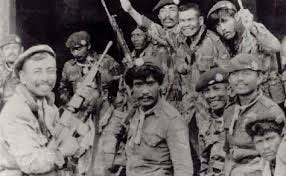
In reality then, the Indonesian invasion of East Timor was part of the Cold War. From 1977–1978, the Indonesian military procured new advanced weaponry from the United States, Australia, and other countries, to destroy Fretilin's networks.
Indeed, the United States furnished over $250,000,000 of military assistance to Indonesia.
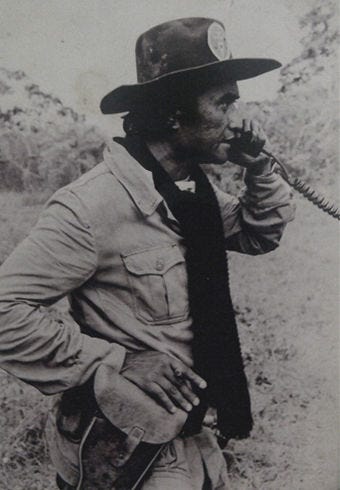
Colonel Dading Kalbuadi, Indonesian commander of Operasi Seroja
[ The full campaign is available HERE ]
It has to be stated that the anti-colonial struggle in Timor Leste was one outcome of political events happening in Lisbon, too.
In April 1974, the leftwing Movimento das Forças Armadas (Armed Forces Movement, MFA) within the Portuguese military mounted a coup d'état against the right-wing authoritarian Estado Novo government in Lisbon (the so-called "Carnation Revolution"), and announced its intention rapidly to withdraw from Portugal's colonial possessions (including Angola, Mozambique and Guinea, where pro-independence guerrilla movements were fighting since the 1960s).
2 FRETILIN is developed out of the Timorese Social Democratic Association (ASDT) which was established early in May 1974. Its founders were drawn from a small group of urban, educated Timorese, mainly government clerks and high school students who had met regularly but informally to discuss the future of their country. Its first major activity was the extension of a strike of a small group of workers into what became virtually a general strike in Dili.
Forming the Committee for the Defence of Labour, the ASDT succeeded in securing a 100 per cent wage increase for public sector workers. This first strike in East Timor’s history, was later followed by the creation of a Union of Workers, a Teachers’ Union and associations of women and students.
On 22 May, 1974, ASDT issued its first political manifesto, calling for independence and an end to colonialism; the immediate participation of ’worthy’ Timorese in the administration; an end to racial discrimination and corruption, and friendly cooperation with neighbouring countries.
Its guiding ideology was nationalism and its broadly social-democratic orientation took a particular form in the light of the Timor situation.
Subsequent political experience and development of ASDT members led to a change in the conception of he form of political organization required.
The need for a development of the national liberation front was formally recognized in the change of ASDT into FRETILIN.
At the ASDT General Assembly on 12 September 1974, a new programme was adopted.
From the beginning ASDT/FRETILIN was the only political party consistently active in the villages, initiating and carrying out concrete projects as well as conducting general political propropaga for independence.
By January 1975 UDT and FRETILIN had hammered out a common platform calling for the transition to self-rule under a coalition of the two parties. The major basis for cooperation was a commitment to independence and democratic right.
[ VIEW Timor-Leste War of Independence, 1975-1999: +2 minutes ]
4 Whereas, the Federation of American Socialists’ Intelligence Resource Program has a different parody which is expanded below:
In contrast with other Portuguese colonies, there was initially in East Timor no liberation movement or armed struggle, though there were sporadic riots or other manifestations of unrest. In 1974 three political associations were formed: the Uniao Democratica Timorense (UDT) which first supported gradual autonomy, and subsequently the granting of independence after a period of association with Portugal, but finally opted for union with Indonesia; the Frente Revolucioniria de Timor-Leste Independente (FRETILIN; this movement initially bore a different name), which advocated independence; and the Associacao Popular Democritica Timorense (APODETI) which favoured integration with Indonesia. Later, the UDT joined a group of pro-Indonesian parties collectively known as the Anti-Communist Movement (MAC).
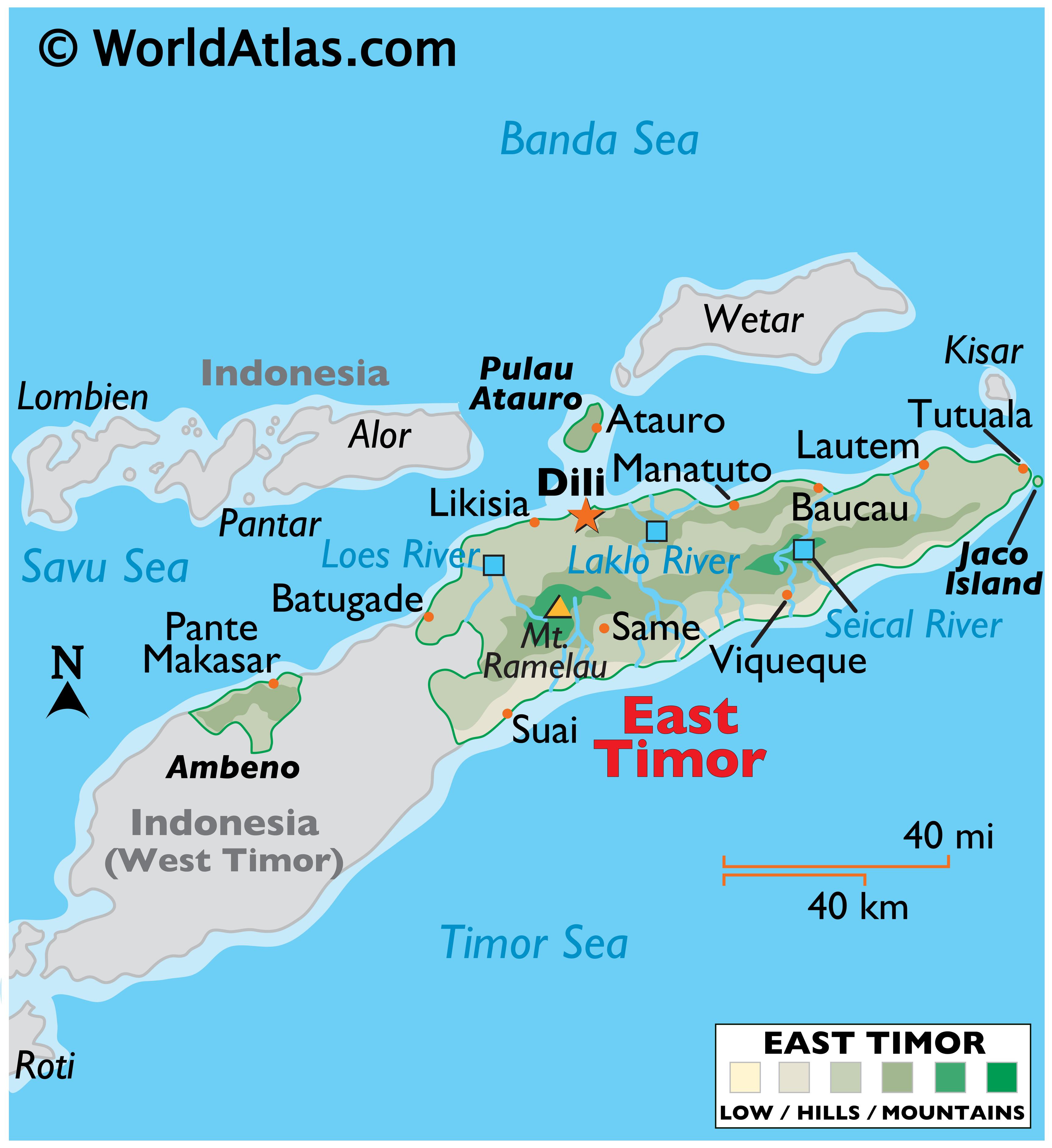
In 1975 Portugal engaged in consultations with these organizations on the future of the Territory. The choice was between independence, integration into a State other than Portugal (which in practice meant Indonesia), or in association with Portugal. The Government in Lisbon made preparations for a general election on the island. The plan was to set up a Popular Assembly. In the meantime local elections took place. But immediately following them the UDT launched a coup d'etat. The FRETILIN responded by staging a counter-coup. The capital of the Territory, Dili, found itself in the hands of the FRETILIN. The fighting involved the various political movements. The Portuguese authorities emphasized that they did not side with any of them. For reasons of safety the authorities left the capital on 26/27 August 1975 and established themselves on the island of Atauro which was part of the Territory.
While the East Timorese political organizations continued to pursue their conflicting policies regarding the Territory's future, Portugal made preparations for further talks with and among them. But the situation became yet more complex when in November 1975 the MAC proclaimed the integration of East Timor with Indonesia and on 28 November 1975 the FRETILIN, for its part, proclaimed the Democratic Republic of East Timor (RDTL). The United Nations did not regard these proclamations as implementing East Timor's right to self-determination A few days later, on 7 December 1975, Indonesian military forces entered East Timor. The next day the Portuguese administration withdrew from Atauro.
Fretilin's ascent in an area contiguous to Indonesian territory alarmed the Indonesian Government, which regarded it as a threatening movement. Following appeals from some of Fretilin's Timorese opponents, Indonesian military forces intervened in East Timor and overcame Fretilin's regular forces in 1975-1976. The culmination of this process was the liquidation of the "zonas de apoio" (logistic bases) of FALINTIL in Mount Matebian in December 1978. Operation Seroja started with massive surrenders of Fretilin cadres and leaders, and culminated with the assassination of the Fretilin (and RDTL) president Nicolau Lobato. Small-scale guerrilla activity persists to this day.
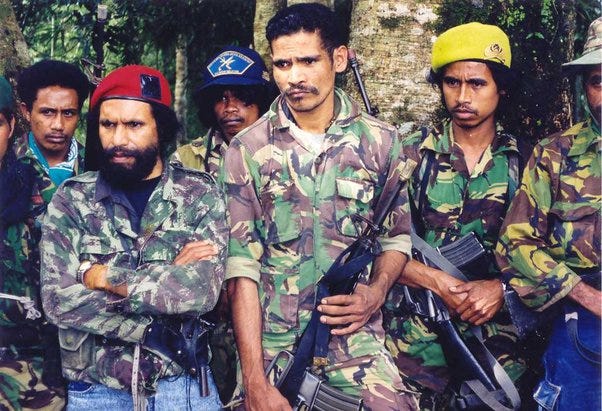
In 1984 the FRETILIN abandoned its position on the alleged existence of the Democratic Republic of East Timor (RDTL). FRETILIN has routinely conducted guerrilla actions ever since the 1975 invasion. As of the mid-1990s, it was estimated that FRETILIN/FALINTIL forces numbered less than 200 combat personnel.
The National Council of Maubere Resistance [CNRM], led by Xanana Gusmao, is a broad-based organisation set up in late 1987 to unify and lead the struggle of the Maubere (East Timorese) people in response internal disputes within the FRETILIN Delegation for Service in the Exterior (DFSE) and within UDT [Timor Democratic Union]. Jose Ramos-Horta was designated in 1989 as the Special Representative of the CNRM abroad. The Secretary of the CNRM Clandestine Resistance Civilian Front, Pedro Nunes (Sabalae) was captured and murderd on 1 June 1995.
FALINTIL, the Armed Forces for the National Liberation of East Timor was formed in 1975. On 20 August 1975 FALINTIL was ordered by FRETILIN to put an end to the "coup d'etat" of UDT which began on August 11, 1975.
[VIEW Guerrilla leader Taur Matan Ruak interview: +3-minute, AP archive]
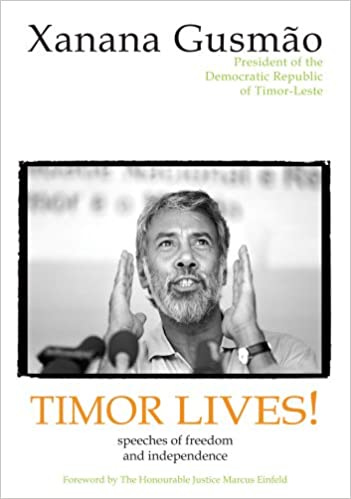
The initial structure of FALINTIL was inherited from the former colonial power. FALINTIL, the armed wing of the East Timorese pro-independence movement, is led by Xanana Gusmao. Gusmao who was condemned to death by Jakarta in 1993 for armed insurrection and then had his sentence commuted for 20 years. Xanana Gusmao was taken out of Jakarta's Cipinang state jail where he had been imprisoned since 1993 and moved to house arrest in February 1999.
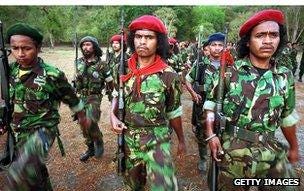
The National Council of Timorese Resistance (CNRT), founded at the First East Timorese National Convention in late April 1998 in Portugal, is a new inclusive umbrella organisation The Timor Democratic Union [UDT], a former political opponent of FRETELIN, is now an ally within the Council of the East Timorese Resistance, along with Apodeti [Timor Democratic People's Association] and KOTA [Kalibun Oan Timor Aswaen]. UDT leader Joao Carrascalao recognized Xanana Gusmao [the jailed Timorese resistance leader] as the resistance's top leader, 20 years after he took up the leadership of the armed struggle. The issue has divided UDT and Fretilin members until the convention. Jose Ramos Horta [Timorese resistance spokesman abroad and 1996 Nobel Peace laureate] was elected vice- president of the national council and of the executive committee.
Updated Sunday, September 12, 1999.
[ VIEW Indonesian soldiers leaving Timor Leste - 2:50-minute, AP archives ]
5 The FRETILIN STRUGGLE
FRETILIN remaining in control can be explained by the eminent suitability of the terrain for guerrilla warfare. However, in the final analysis, the deciding factor is the support of the people themselves.
FRETILIN’s ability to win the confidence of the rural population and to mobilize them against Indonesian aggression is a tribute to the work done in the countryside and to the rapid development of a political, cultural and economic programme.
BIBLIOGRAPHY
Australian Council for Overseas Aid, Report on a Visit to East Timor (Canberra, 1975)
Evans, G, ‘Timor the Dynamics of Underdevelopment and Independence’, Intervention (No 5, 1975)
‘Portuguese Timor’, New Left Review (91, 1975)
Freney, D, ‘East Timor The Modest Revolution’, Australian Left Review (48, September 1975)
Timor: Freedom Caught Between the Powers (Spokesman Books, 1975)

Joliffe J, ‘Timor History of the Revolution’, Nation Review (3-9 October 1975)
‘The Book Revolution in East Timor’, National U (AUS, Melbourne), (31 April 1975)
Ranck, F, Timor, New Guinea Quarterly (Vol 10, no 1, May-June 1975)
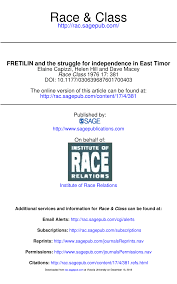
Elaine Capizzi, Helen Hill and Dave Macey FRETILIN and the struggle for independence in East Timor, (Victoria University Melbourne, April 1976)
FRETILIN’s Programme and What is FRETILIN? are included in The Struggle for East Timor (Europe-Third World Research, London, 1976)